Third places

Since 2013, the Plateau Urbain cooperative has helped to create more than 50 third places in major French cities. With their collective and ephemeral nature, these places are breeding grounds for social, economic, and cultural innovations that have a lasting impact on the local area.

Third places are characterized by their ability to pool spaces and skills, while creating connections and innovation. In the 1980s, American sociologist Ray Oldenburg first defined the term "third place" as an informal space outside the home (first place) and the workplace (second place) that encourages spontaneous gatherings. Taking the form of collaborative workspaces, fablabs, rehabilitated urban wastelands, or mixed-use spaces combining offices and emergency accommodation, these places for "doing things together" are catalysts for innovation, thanks in particular to their common areas, which are conducive to encounters and collaboration. Initially found in large cities, these hybrid spaces are now spreading to rural areas, small and medium-sized towns, and suburban neighborhoods. With no standard model, they are shaped according to the needs of citizens, businesses, and local characteristics. Open to all, they are a space for experimentation for a new vision of creating innovation and value in local areas. For example, solidarity-based third places are defined by a clear social objective, promoting citizen participation, the social and solidarity economy, and democratic transitions, while offering discovery and training services and supporting local community projects.
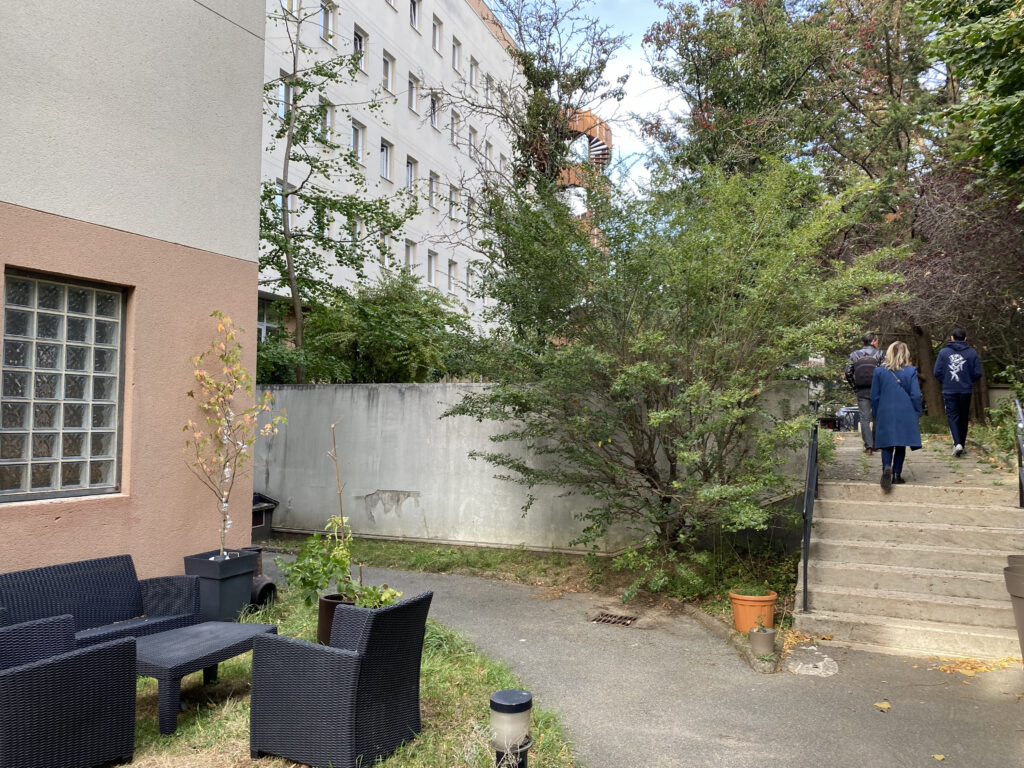
The Plateau Urbain cooperative offers to assist property owners in creating third places in their vacant buildings. These places are distinguished by their temporary nature. They are set up in premises that are temporarily empty, often earmarked for future redevelopment, and are therefore occupied on a temporary basis, for a period ranging from a few months to several years. Temporary occupation is a concept similar to that of transitional urban planning , which operates on a larger scale, such as a neighborhood. The aim is to invest in the city's temporal interstices in order to breathe new life into unused spaces, while helping to revitalize a building, a street, a neighborhood, and the surrounding area. Thus, the third places set up and managed by Plateau Urbain position themselves as agile incubators, temporarily inserting collective dynamics into previously neglected spaces, while stimulating social and economic innovation within the local community in a more profound way.

Transitional third places represent a real estate opportunity, offering low-cost facilities. For most occupants of spaces managed by Plateau Urbain, this is their first opportunity to set up shop, meeting a significant demand for affordable premises. In addition to the economic benefits, social interactions and diversity among occupants are essential. Common areas and site managers play a key role in collective dynamics and professional collaborations. Finally, the third place ecosystem is appealing, with a majority of occupants wishing to repeat this positive experience.


The spaces that the cooperative sets up and manages are varied in type thanks to collaborations with different partners and owners. Whether they are public authorities, institutional investors, private owners, or social landlords, these spaces are adapted to projects defined according to possibilities and needs. Some, such as Les Arches Citoyennes and Césure, third places in Paris, as well as Coco Velten in Marseille, include emergency accommodation and professional activities, promoting the breaking down of barriers between different groups and sectors. Others, such as Espace Voltaire (Paris) and La Halle Girondins (Lyon), consist solely of workspaces and sometimes shops, offering temporary space to priority beneficiaries such as artists, artisans, entrepreneurs, and community project leaders. Our projects
In 2020, Plateau Urbain, in partnership with the University of Leuven, surveyed the occupants of 15 temporary spaces. This analysis provided a better understanding of the profile of the structures, their satisfaction, their interactions, and their future real estate needs. The results highlight a diversity of activities, bringing together associations, companies, self-employed entrepreneurs, and workers affiliated with the artists' house. The structures are predominantly young, confirming the effectiveness of the temporary occupancy model in supporting the creation of activities. They include painters, jewelry designers, entrepreneurs in ecology, microbrewers, sculptors, publishers, chocolatiers, graphic designers, film producers, dancers, and web developers: discover the occupants who bring our third places to life! The occupants
Since its creation, Plateau Urbain has adopted an open approach to event programming, leaving room for a diversity of activities and audiences. Events, whether conferences, open houses, concerts, or exhibitions, promote exchanges and collaborations between occupants. Responsibility for managing the programming lies with the organizations based there, contributing to great diversity and a vibrant atmosphere. What's happening at the venues
Free ‘Travel Like a True Adventurer’ E-book